Choose a starting tempo you can trust
A tempo ladder is a sequence of practice rounds at gradually changing BPM values. Begin below the tempo where the passage becomes unreliable—not at the edge of failure. Your first rung should let you play with good rhythm, useful motion, and enough spare attention to hear what is happening.
“Clean” does not have to mean mechanically perfect. It means the fingering, sticking, bowing, breathing, or articulation remains organized; the pulse stays steady; and a small mistake does not pull the whole phrase apart. If the first round already feels like a test, lower the starting BPM until it feels like information instead.
Make the rungs close enough to hear
For many passages, increases of two to four BPM are useful. Smaller steps make sense near a technical ceiling, in exposed music, or when a tiny change affects coordination. Larger steps can work at the beginning of an easy warm-up, but they reveal less about where control starts to thin.
The number matters less than the size of the musical change. Four BPM at a slow tempo can feel substantial; the same increase at a quick tempo may barely register. Pick an increment that asks a new question without changing every part of the answer.
- Settle
- 72 BPM
- Easy motion and a clear pulse
- Confirm
- 76 BPM
- Two composed repetitions
- Build
- 80 BPM
- Listen for the first change in effort
- Test
- 84 BPM
- Advance only if the phrase stays shaped
- Consolidate
- 80 BPM
- Finish below the day’s highest rung
Give every round a decision
Decide in advance what earns the next rung. Two or three composed repetitions are usually more useful than one lucky pass. Between rounds, choose one of three actions:
- Advance when the pulse, motion, and musical shape remain dependable.
- Hold when the passage works but still needs too much concentration or force.
- Step back when tension grows, rhythm blurs, or the same failure repeats.
A held tempo is not wasted time. It is often the round in which the nervous system stops surviving the passage and starts learning it. Likewise, stepping back is part of the ladder rather than a fall from it.
When the ladder stops climbing
A plateau can mean several different things. The passage may need a smaller increment. One transition may need to be isolated. The hands may understand the notes but not the motion that connects them. Or attention may simply be spent for the day.
Try one change at a time: reduce the increment, shorten the passage, alter the rhythm, practice a neighboring tempo, or return to a rung where the phrase feels generous. Then finish with one calm repetition below the highest successful tempo. This leaves a clearer physical memory than ending on several forced attempts.
When you return tomorrow, begin a few rungs below the previous peak. A tempo becomes useful when it can be found again—not merely touched once.
Let the rungs arrive on time.
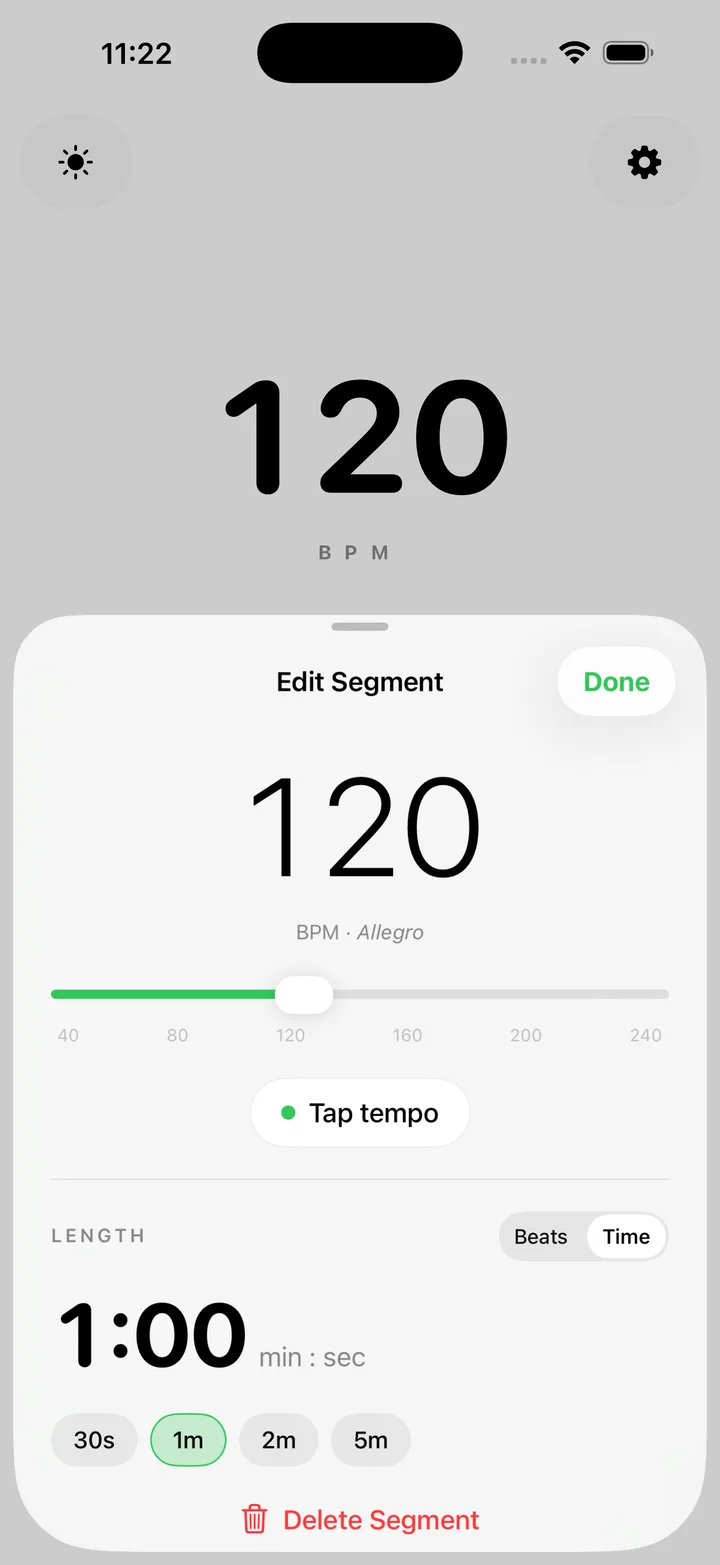
Metrognomicon can play a ladder as a sequence of equal-length tempo segments, with a count-off before each change. Set the phone down, keep your hands on the instrument, and listen for the moment a new rung stops being useful.
View Metrognomicon on the App Store