Begin with a tempo map
Before turning on a metronome, mark the piece by tempo section. A section might be a movement, a rehearsal letter, eight bars of transition, or a single troublesome phrase. The divisions should follow what the music asks you to do—not necessarily what the double bars suggest.
For each section, write down three things:
- The working BPM you can play cleanly today.
- The section length, measured in bars, beats, or elapsed time.
- How the next tempo arrives: abruptly, by accelerando, or by ritardando.
- Opening
- 72 BPM
- 8 bars, settled and spacious
- Middle section
- 96 BPM
- 16 bars, immediate change
- Climb
- 96 → 112
- 8 bars, gradual acceleration
- Coda
- 84 BPM
- To the end, broadening
This small map turns “practice the piece” into a set of concrete jobs. It also reveals where a conventional, single-tempo metronome would make you stop, reset, and lose the shape of the passage.
Practice the doorway, not only the rooms
Musicians often drill each tempo separately and assume the transition will take care of itself. It rarely does. The body learns the pulse it has been repeating; a new pulse must be prepared before it arrives.
Take the final two bars of one section and the first two bars of the next. Loop that four-bar window. If the change is abrupt, hear the destination tempo internally before you cross the bar line. A four-beat count-off before the change can make the new pulse unmistakable without interrupting your hands or breath.
Give each kind of change its own method
For an abrupt change
Choose exact BPM values for both sides. Practice landing directly on the new pulse, first with a count-off and then without it. Keep the musical gesture intact; the goal is not to bolt two sterile exercises together.
For accelerando and ritardando
Start by placing a few stepping-stone tempos through the transition. An accelerando from 80 to 104 might become short segments at 80, 86, 92, 98, and 104. At first, make the steps audible and even. Then lengthen the sequence and smooth the joins until the curve feels intentional rather than lurching.
A ritardando works the same way in reverse. Decide where it begins, where it must arrive, and how much musical space the slowing occupies. “Gradually slower” becomes much easier to judge when the endpoints are no longer vague.
Run the whole passage hands-free
Once the individual changes are secure, stop touching the metronome. Set the complete sequence, put the phone where it can be heard, and play from the first section through the last. A hands-free run preserves the physical and musical continuity that disappears whenever you pause to dial a new number.
Use a compact set of practice rounds:
- Map every section at a comfortable working tempo.
- Loop the transitions in short windows.
- Run the complete sequence once without stopping.
- Raise the tempos slightly and repeat only if the run stays composed.
The increase need not be dramatic. Two to four BPM per round is often enough. If one transition unravels, lower that section or widen the transition window instead of forcing the entire piece forward.
Let the map keep time.
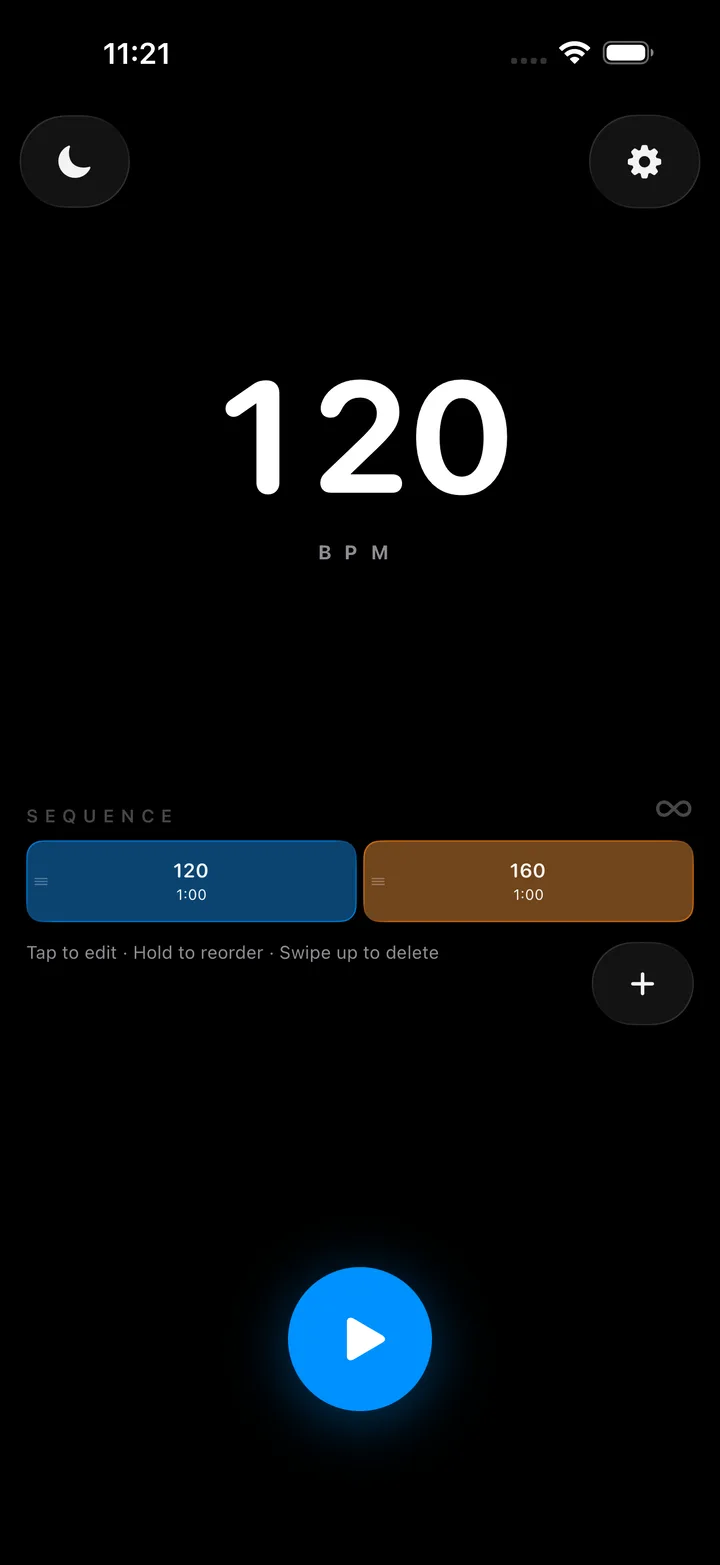
Metrognomicon was built for this exact sort of practice: tempo segments with their own BPM and length, a count-off before changes, and one uninterrupted run from beginning to end.
View Metrognomicon on the App Store